Best Workforce Management Softwares: 2025

In 2025, Workforce Management (WFM) has transcended its traditional role as a back-office function to become a critical driver of organizational success. Modern WFM platforms now integrate key operational components, including scheduling, performance management, payroll, compliance, and employee engagement, into a unified, intelligent system.
As businesses navigate the complexities of hybrid work models, global talent pools, and evolving regulatory landscapes, reliance on spreadsheets and legacy tools is no longer viable. Today’s WFM solutions empower organizations to deploy the right talent in the right roles at the right time, while seamlessly aligning individual performance with broader strategic objectives.
According to Market.us, the global WFM software market is projected to reach $18.4 billion by 2025, growing at a CAGR of 14.2%.
Types of Workforce Management
- Time & Attendance Management
- Automated tracking of employee hours, overtime, and absenteeism.
- Example: Cleveland Clinic uses UKG to manage thousands of nurse shifts efficiently.
- Scheduling & Shift Optimization
- Helps in demand forecasting and ensures adequate staffing.
- Example: Starbucks uses scheduling platforms to allocate barista shifts across thousands of stores. (Business Insider)
- Performance & Talent Management
- Continuous goal alignment, OKRs, reviews, and skill development.
- Example: Tech firms use PossibleWorks to map employee skills with organizational goals.
- Payroll & Compliance Management
- Streamlines payroll while ensuring adherence to complex wage and tax laws.
- Example: Manufacturing companies use ADP/Dayforce for U.S. multi-state payroll compliance.
- Analytics & Forecasting
- Predicts staffing needs and labor costs with AI-driven insights.
Importance of Workforce Management
- Boosts Productivity: Automates repetitive tasks, freeing managers for strategic work.
- Ensures Compliance: Protects businesses from labor law violations.
- Engages Employees: Builds transparency and accountability through continuous feedback.
- Optimizes Costs: Cuts down on overtime and prevents overstaffing.
- Enables Data-Driven Decisions: Provides actionable insights through workforce analytics.
Top 5 Workforce Management Software in the (2025)
1. Rippling
Overview
Rippling is one of the fastest-growing HR platforms in the U.S., offering all-in-one HR, IT, and payroll automation.
Strengths
- 500+ integrations with SaaS apps.
- Automates onboarding, payroll, and even IT device provisioning.
Example: A Silicon Valley startup scaled from 50 to 500 employees in less than two years using Rippling to centralize HR and IT operations. (Rippling Case Studies)
Best For: Startups and mid-sized firms.
Watch Outs: Costs can escalate as modules are added.
2. PossibleWorks
Overview
While many WFM systems are heavy on compliance and scheduling, PossibleWorks takes a unique approach: it places performance and skills at the heart of workforce management. Instead of being a once-a-year HR exercise, it transforms WFM into a daily experience for employees and managers alike.
Key Differentiators
- Skill-linked performance management: Employee goals and outcomes are directly tied to skill development.
- Continuous feedback ecosystem: Enables frequent, constructive conversations instead of yearly reviews.
- Simple, one-screen interface: Built for ease of adoption across all levels of employees.
- Supports OKRs & KPIs: Aligns CEO goals down to individual employees seamlessly.
Why It Stands Out in 2025
PossibleWorks is ideal for companies that believe employee engagement = business growth. Unlike traditional WFM tools that mainly optimize costs, PossibleWorks ensures every employee is motivated and aligned with company strategy.
Real-World Example
- A mid-sized IT services firm in India replaced annual reviews with PossibleWorks’ continuous performance feedback system. Within 12 months, they saw:
- 20% improvement in employee productivity.
- 25% increase in employee satisfaction scores.
- Managers reported spending 30% less time chasing review paperwork. (PossibleWorks Blog)
Best For: Mid-sized firms, fast-growing startups, and companies looking to enhance engagement and performance.
Watch Outs: It focuses primarily on performance and engagement, so firms may need to integrate payroll or advanced scheduling separately.
3. UKG (Ultimate Kronos Group)
Overview
UKG is a pioneer in workforce scheduling, compliance, and HCM solutions. It’s widely used in industries with complex scheduling needs like healthcare, retail, and manufacturing.
Strengths
- Advanced scheduling and time-tracking.
- Industry-leading compliance management.
Example: Cleveland Clinic deployed UKG to manage 70,000+ employee schedules, ensuring better shift coverage and reduced overtime costs. (UKG Healthcare Solutions)
Best For: Large enterprises in shift-heavy sectors.
Watch Outs: Steeper learning curve, especially for new managers.
4. Ceridian Dayforce
Overview
Dayforce is an enterprise-grade solution that integrates HR, payroll, benefits, and workforce management. Its real-time payroll calculations set it apart.
Strengths
- Unified HCM platform.
- Strong compliance support.
Example: Spirit AeroSystems, one of the world’s largest aerospace suppliers, uses Dayforce to unify global workforce operations and improve compliance. (Ceridian Case Study)
Best For: Large organizations with complex HR and compliance needs.
Watch Outs: Long implementation timelines.
5. PerformYard
Overview
PerformYard is designed to simplify performance reviews and employee feedback, helping companies create high-performance cultures.
Strengths
- Customizable performance review cycles.
- Supports 360° feedback and OKRs.
Example: A U.S.-based consulting firm reported a 30% increase in employee satisfaction after adopting PerformYard for structured reviews. (PerformYard Case Study)
Best For: Mid-market companies focused on performance-driven culture.
Watch Outs: Not a complete WFM suite, best as a performance management layer.
Comparison Table
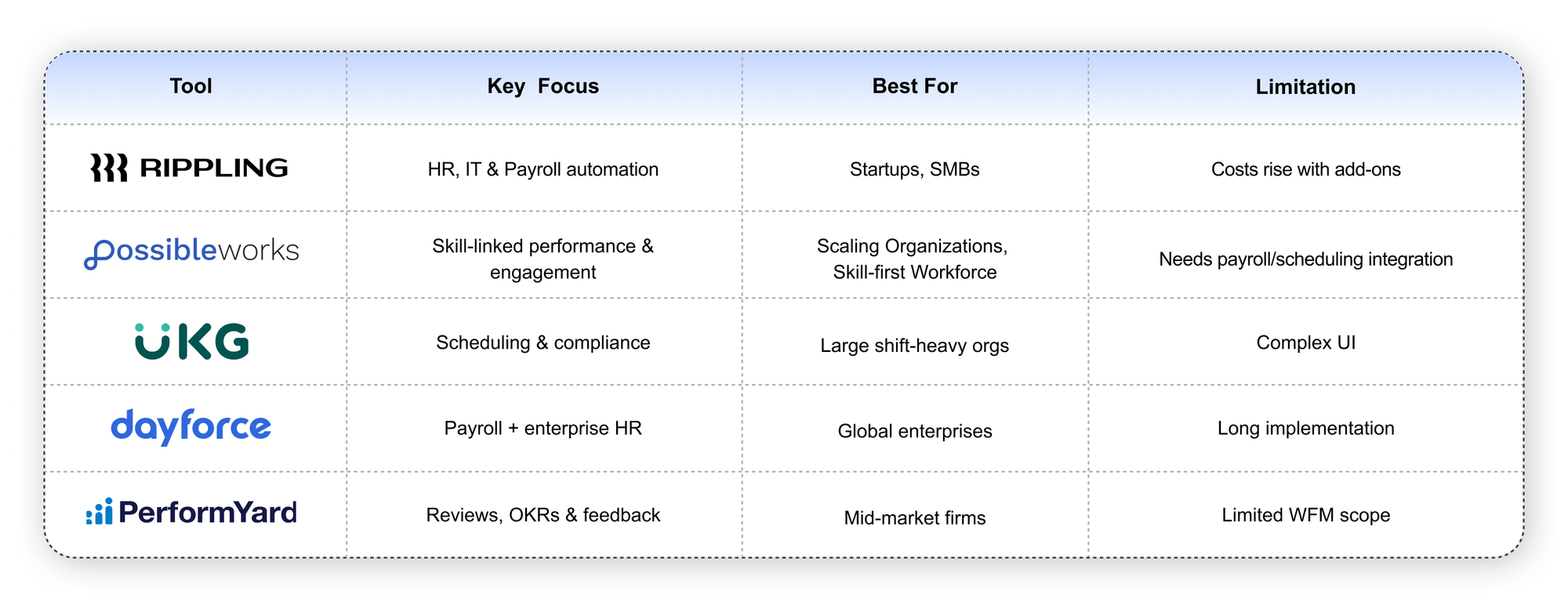
Workforce Management in 2025 is no longer just about reducing costs, it’s about building engaged, high-performing, and compliant organizations.
- Rippling is great for automation-focused startups.
- PossibleWorks is the best choice for companies that want to align skills, goals, and engagement.
- UKG and Dayforce are reliable for large enterprises needing compliance and scheduling.
- PerformYard works well for performance-driven mid-market firms.
Modern WFM platforms bring together skills, performance, compliance, and analytics to create smarter, more engaged organizations. As work becomes increasingly hybrid and skills-driven, businesses need tools that align individual goals with company strategy. The right workforce management platform doesn’t just manage employees—it empowers them to grow, contribute, and drive sustainable business success.